Last updated: November 2026. For information only, not medical advice.
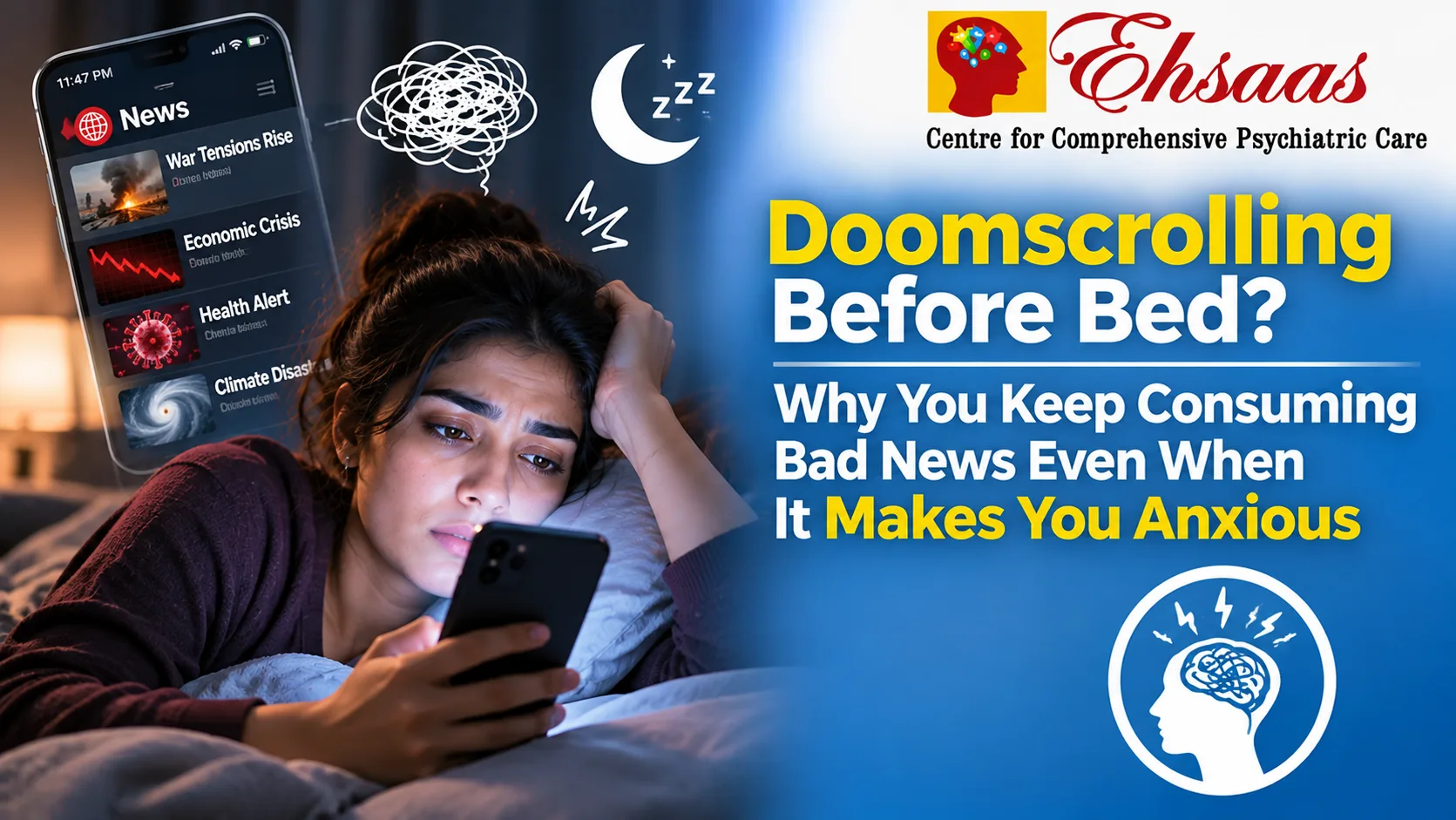
You keep reading bad news because your brain treats threats as urgent and hopes more information will bring control. The relief rarely comes, and doomscrolling before bed can raise anxiety and disturb sleep. Understanding this loop is the first step to breaking it.
It is late, you meant to check one headline, and an hour later you are tense, wide awake and still scrolling. If you cannot stop, or your sleep and mood are suffering, a psychiatrist in Delhi can help you work out what is driving it.
What is doomscrolling?
Doomscrolling is the habit of continuing to scroll through negative news or posts long after it stops being useful, even when it makes you feel worse. It differs from staying informed in three ways: it feels hard to stop, it leaves you more anxious instead of better prepared, and it often runs for far longer than you planned.
The term is informal and not a medical diagnosis. Related phrases such as news anxiety, bad news anxiety, headline stress and news fatigue are also everyday descriptions of the same experience. Researchers measure it with short questionnaires about how often you check negative news and how hard it is to stop.
It is common. Notifications, autopsy and endless feeds make it easy for anyone to fall into.
Why do we keep consuming bad news even when it makes us anxious?
We keep reading bad news because the brain gives threats extra weight, and scrolling feels like a way to gain control over uncertainty. Endless feeds, alerts and quiet night-time hours remove natural stopping points, so the habit continues even when it raises anxiety.
It feels illogical, but several ordinary mental habits work together:
- Negativity bias: the brain gives more weight to threatening information than to good news, because noticing danger once helped survival.
- The search for control: people often scroll hoping to feel prepared. Clinicians note the irony that the habit meant to reduce anxiety can raise it.
- Uncertainty and fear of missing out: when events are unfolding, "one more update" feels necessary.
- Design of feeds: infinite scroll, autopsy and push alerts remove natural stopping points.
- Night-time quiet: with fewer distractions at bedtime, worries get louder, and the phone is within reach.
- Habit and avoidance: scrolling can also be a way to avoid your own feelings. This overlaps with emotional avoidance and digital burnout.
People with existing anxiety may be more sensitive to this cycle, because uncertainty is harder for them to tolerate.
How does doomscrolling before bed affect sleep and mental health?
Bedtime is the worst time for bad news. Stressful content keeps the mind alert when it should be winding down, and screen light adds to the problem. In a June 2025 survey of 2,007 US adults by the American Academy of Sleep Medicine (AASM), reported by HealthDay News in February 2026, 38% said using a phone or tablet to read news before bed makes their sleep slightly or significantly worse.
Research more broadly links doomscrolling with:
- Poorer sleep quality and delayed sleep, which is one of the clearest patterns in the studies
- Higher anxiety, stress and depressive symptoms, found in several studies, including one among nursing students in Chandigarh
- Lower mood and optimism after even short exposure to negative news
- Feeling helpless or overloaded, sometimes described as headline stress
A vicious cycle can form: bad news raises anxiety, anxiety disturbs sleep, poor sleep makes the next day's mood and stress tolerance worse, and the tired mind scrolls again. Most of this evidence is observational, so it shows links, not that doomscrolling alone causes anxiety or insomnia. If poor sleep persists, read more on anxiety and depression.
What are the signs that doomscrolling is becoming a problem?
Doomscrolling is becoming a problem when you cannot stop even though you want to, and you feel anxious, hopeless or drained afterwards. Poor sleep, constant tension and guilt about lost time are other signs. The list below helps you check.
- You open news or social apps automatically, without deciding to
- You scroll longer than planned and find it hard to stop, even when you want to
- You feel anxious, angry, sad or hopeless afterwards
- You check news first thing in the morning or last thing at night
- Your sleep is late, light or disturbed after scrolling
- You have trouble concentrating or feel constantly on edge
- You feel guilty about the time spent, or avoid work and people to keep scrolling
- Headlines trigger racing thoughts, a pounding heart or stomach discomfort (see panic attacks vs anxiety)
A simple check: after you read the news, do you feel informed and oriented, or drained and tense? Staying informed usually leaves you oriented. Doomscrolling usually leaves you depleted.
Healthy news habits vs doomscrolling: what is the difference?
A healthy news habit is short, planned and drawn from a few reliable sources, and it leaves you informed and calm. Doomscrolling is open-ended, often happens late at night and leaves you tense. The table compares the two.
| Aspect | Healthy news habit | Doomscrolling |
|---|---|---|
| Control | You decide when and how long | The feed decides, you struggle to stop |
| Timing | Set windows, such as 15 minutes in the morning | Anytime, especially in bed or at night |
| Sources | A few reliable outlets | Endless feeds, forwards and comment threads |
| Purpose | To understand and act if needed | To seek reassurance or avoid feelings |
| How you feel after | Informed, calmer, ready to move on | Tense, hopeless, drained |
| Effect on sleep | Little or none | Delayed, light or broken sleep |
| Action taken | Clear step, or a decision to let go | None, just more scrolling |
How can you stop doomscrolling? 8 practical ways
To stop doomscrolling, take the phone out of the bedroom, set a news cut-off time and limit news to one or two short daily windows. Turn off alerts, choose a few reliable sources and replace the scroll with a calming habit. Eight steps follow.
- Keep bed news-free. Charge your phone outside the bedroom or across the room. If bedtime is your doomscrolling window, this one change helps most.
- Set a news cut-off time. For example, no news after 8 PM, and use a screen-time limit on news and social apps.
- Choose a news window. Check headlines once or twice a day for 10 to 15 minutes, then stop.
- Turn off push alerts. Notifications pull you in; you can pull the news yourself.
- Curate your sources. Follow two or three reliable outlets and mute accounts that post only alarming content.
- Ask "what can I do?" If there is an action, such as donating or voting, take it. If not, let the story go.
- Replace the habit. Keep a book, calming music, a short breathing exercise or a journal where you used to scroll. Our stress management guide has simple techniques.
- Pause the urge. When you reach for the phone, wait two minutes and notice the feeling that triggered it. Often it is anxiety, not curiosity.
If you cannot cut down despite trying, or the anxiety stays high, that is a good reason to seek professional support. If you ever have thoughts of harming yourself, seek help immediately.
When should you see a psychiatrist in Delhi?
See a psychiatrist in Delhi if anxiety stays high, sleep is poor for two weeks or more, or you cannot stop scrolling despite trying. An assessment can check for anxiety, depression or insomnia and plan suitable care. Results vary.
Consider a consultation if:
- You feel chronically on edge, or anxiety stays high even after you cut down on news
- You want to stop scrolling but cannot
- Sleep has been poor or disturbed for two weeks or more
- Low mood, hopelessness or loss of interest has appeared
- Headlines trigger panic, health anxiety or obsessive worry
- Work, studies or relationships are suffering
A psychiatrist can assess whether the problem is linked to anxiety, depression, insomnia or another condition, and discuss options such as therapy, sleep and lifestyle changes and, where clinically needed, medication. Treatment is individual, and results vary.
To book, contact us. If you have thoughts of harming yourself, please seek help immediately by calling a local emergency number or going to the nearest hospital.
This article is for general awareness and is not a substitute for professional medical advice, diagnosis or treatment.
About the doctor
Dr Manish Sarkar is a consultant psychiatrist in Delhi, practising at Ehsaas in Chittaranjan Park (MBBS; DPM, Diploma in Psychological Medicine, from NIMHANS, the National Institute of Mental Health and Neurosciences, Bangalore; FIPS, Fellow of the Indian Psychiatric Society; FADP). He is the founder of Ehsaas – Centre for Comprehensive Psychiatric Care.
Clinic: Ehsaas, J-1976, Chittaranjan Park, New Delhi – 110019
Timings: Mon–Sat 10:00 AM–1:00 PM and 5:00 PM–9:00 PM; Sunday 5:00 PM–9:00 PM
Phone: 9717755296 · 8527830987 · 011-41635296
Frequently Asked Questions
What is doomscrolling?
It is the habit of compulsively scrolling through negative news or posts, often long after it stops being useful and while feeling worse.
Why can't I stop reading bad news?
Negativity bias, the urge for control, uncertainty, and feeds designed with no stopping point all pull you back. Anxiety can also make the habit stronger.
Does doomscrolling before bed affect sleep?
It can. In a June 2025 American Academy of Sleep Medicine (AASM) survey of 2,007 US adults, 38% said reading news on a phone or tablet before bed made their sleep worse.
Is doomscrolling a mental health disorder?
No. It is an informal term, not a diagnosis. But it is linked with higher anxiety, stress and poorer sleep in several studies.
How do I stop doomscrolling at night?
Keep your phone out of reach of the bed, set a news cut-off time, turn off alerts and replace scrolling with a calming routine.
Is it okay to read the news at all?
Yes. Staying informed is useful. Limit it to short, set windows from reliable sources and stop when you feel tense.
Can doomscrolling cause insomnia or anxiety?
A 2026 survey of nursing students in Chandigarh found associations with anxiety, stress and depressive symptoms, not proof of cause. Doomscrolling can worsen sleep and anxiety in some people, and existing anxiety can drive more doomscrolling.
When should I see a psychiatrist?
If anxiety, poor sleep or low mood lasts two weeks or more, or you cannot stop despite trying, book a consultation at Ehsaas, Chittaranjan Park, Delhi.

Medically reviewed by
Dr. Manish Sarkar , MBBS, DPM (NIMHANS), FIPS, FADP
This page is for general information and is not a substitute for a consultation. Treatment is decided individually after assessment.
References
- American Academy of Sleep Medicine. Doomscrolling affecting many Americans' sleep, poll finds. HealthDay News, 25 February 2026 (survey of 2,007 US adults, June 2025).
- The hidden mental health cost of news on social media. Psychology Today, January 2026.
- Doomscrolling, anxiety, stress and depressive symptoms among undergraduate nursing students. Indian Journal of Indian Psychology, 2026.
- Doomscrolling and mental health overview. Tava Health.