Last updated: November 2026. For information only, not medical advice.
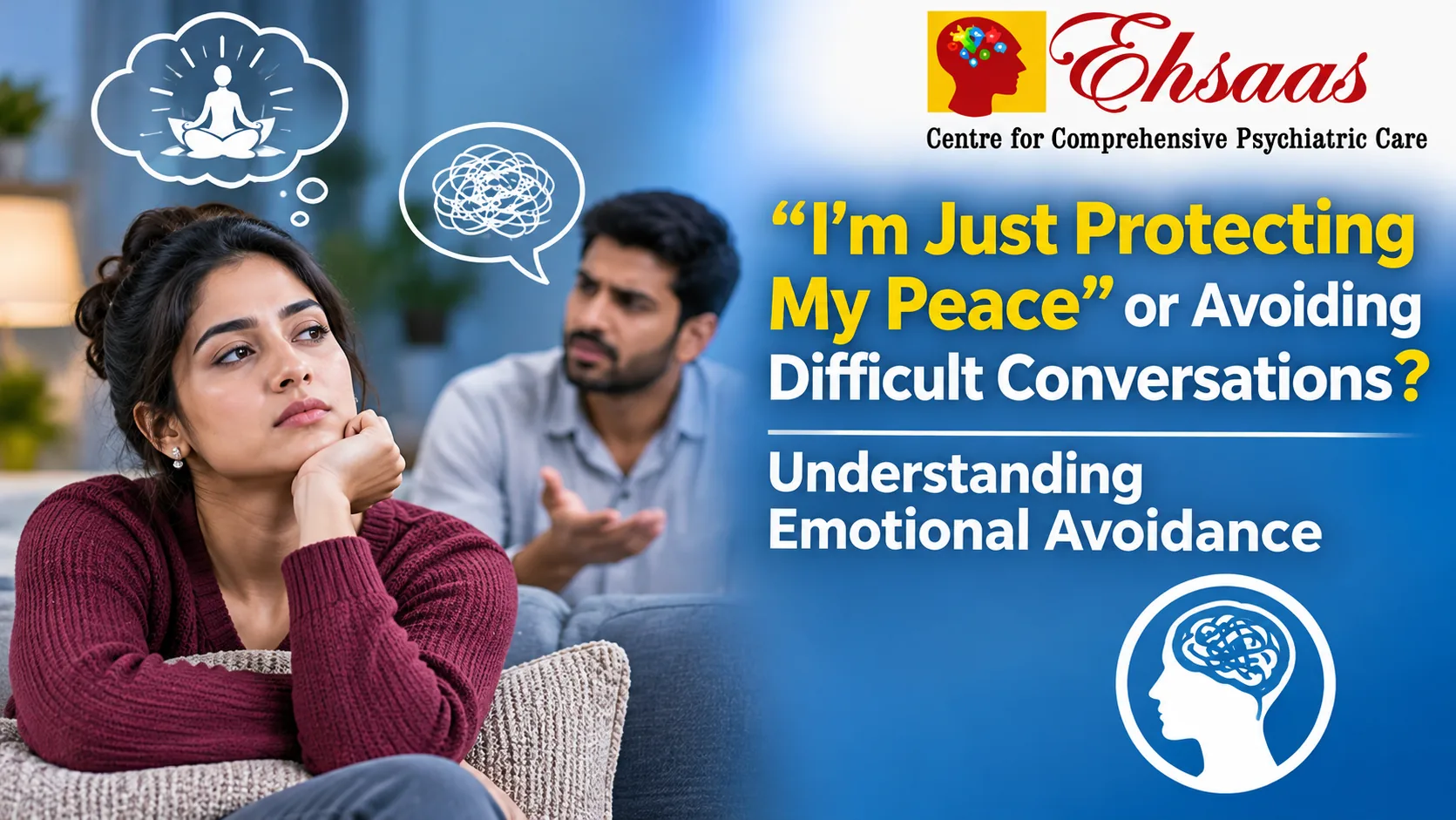
Protecting your peace means setting a boundary to guard your well-being. Emotional avoidance means dodging a conversation or a feeling because it is uncomfortable. The difference shows in what happens next: a healthy boundary leaves you calmer and the relationship workable, while avoidance lets the problem grow and the anxiety keep returning.
"I'm just protecting my peace" has become a popular line on social media. Sometimes it is true and healthy. Other times it quietly covers for avoiding difficult conversations, suppressing emotions or running from conflict. If avoidance is starting to affect your sleep, work or relationships, a consultation with a psychiatrist in Delhi can help you sort out what is going on.
What is emotional avoidance?
Emotional avoidance is the habit of steering away from uncomfortable feelings, thoughts or situations instead of facing them. Psychologists also call a broad form of it experiential avoidance: an unwillingness to stay in contact with painful emotions, memories, thoughts or body sensations. It can look like changing the topic, going silent, staying busy, scrolling, over-working, joking things away or simply leaving the room.
Avoidance is not always a problem. Stepping back for a few minutes to cool down is a normal avoidance coping strategy and can even prevent a fight. It becomes a concern when it turns into the default response. Research reviews describe it as a short-term relief strategy that can keep anxiety, depression and other stress-related problems going when it is used excessively.
A few related terms you may have heard:
- Emotional suppression: pushing a feeling down so no one, including you, has to deal with it.
- Conflict avoidance: agreeing, staying quiet or withdrawing to prevent any disagreement.
- Stonewalling: shutting down and refusing to engage in a discussion, often in close relationships.
- Avoidance coping: any pattern of escaping a stressors rather than managing it.
Protecting your peace vs avoiding: how can you tell the difference?
You can tell the difference by checking what the choice does to the problem. Protecting your peace sets a clear limit, leaves you calmer and keeps the relationship workable. Emotional avoidance only postpones the issue, so relief fades into guilt, tension or resentment within days. The table below compares the two.
| Question to ask yourself | Protecting your peace | Emotional avoidance |
|---|---|---|
| What is the motive? | Guard your well-being and values | Escape discomfort, fear or guilt |
| Is the issue addressed? | Yes, calmly or with a clear limit | No, it is pushed aside or ignored |
| How do you feel afterwards? | Settled, clearer, lighter | Relief first, then tension, guilt or dread returns |
| Is the other person informed? | You state the limit clearly | They are left guessing, or you ghost or go silent |
| Is it flexible? | You can revisit it when calm | Fixed rule: "I never discuss this" |
| What happens over time? | Relationships feel safer and more honest | Resentment, distance and repeated arguments grow |
A useful example: if a relative keeps criticising your career, saying "I will not discuss my job at family dinners, but I am happy to talk about anything else" is protecting your peace. Letting the comments build up for months, then cutting contact without a word, is avoidance. One keeps the door open with a limit. The other closes it without explanation.
Why do people avoid difficult conversations?
Avoidance is rarely laziness. It is usually the mind trying to protect itself, and it works well enough in the moment to be repeated. Common reasons include:
- Fear of conflict or rejection: worry that speaking up will end the relationship or cause a fight.
- Anxiety: people with high anxiety often avoid what triggers it, which gives short relief and strengthens the fear. See our page on anxiety treatment.
- Childhood patterns: growing up in homes where anger was unsafe or feelings were not discussed teaches children to stay quiet.
- Cultural expectations: in many Indian families, "adjust kart", keeping the peace and not upsetting elders can make open disagreement feel disrespectful.
- Low self-worth or people-pleasing: a belief that your needs are less important than other people's comfort.
- Past hurt or trauma: when earlier conversations went badly, avoiding them feels safer.
- Overwhelm and burnout: when you are already exhausted, even a small talk can feel too heavy. This is common with stress and digital burnout.
The trap is that each time you avoid, the mind learns that avoidance is what keeps you safe. The next difficult conversation then feels even bigger.
What are the signs of emotional avoidance, and how does it affect mental health?
You may be relying on emotional avoidance if several of these feel familiar:
- You say "I'm fine" or "it doesn't matter" when it clearly does.
- You delay or cancel conversations you know you need to have.
- You keep yourself constantly busy, or turn to your phone, food, alcohol or work when a feeling rises.
- You agree to things you do not want, just to avoid an argument.
- You go silent, leave the room or stop replying when a topic gets tense.
- You feel relief after avoiding, followed by guilt, irritability or a sense that nothing is solved.
- Old arguments keep repeating because the real issue is never discussed.
- You feel emotionally numb, tired or disconnected from people close to you.
How it can affect mental health. A published review of the research links experiential avoidance with anxiety, depression, obsessive-compulsive symptoms and post-traumatic stress. A 2022 meta-analysis found a moderate-to-large association between avoidance and both anxiety and depressive symptoms. This shows a link, not proof that avoidance alone causes these conditions, and many factors play a part.
In daily life, long-term avoidance can lead to:
- Rising anxiety and constant low-level worry
- Low mood and a flat, empty feeling, which can overlap with depression
- Irritability or sudden anger when suppressed feelings finally spill over (see how to control anger issues)
- Strained marriages and families, where partners feel shut out (see marital problems counselling)
- Trouble sleeping, headaches or body tension linked to unprocessed stress
How can you handle difficult conversations instead of avoiding them? 7 practical ways
You can handle a difficult conversation by naming your feeling, choosing a calm moment, using "I" statements and stating a clear boundary instead of going silent. Start with small topics and take planned breaks rather than leaving for good. The seven steps below build this skill gradually.
- Name the feeling first. Say it to yourself: "I feel anxious, hurt or angry." Labelling an emotion makes it easier to manage than pushing it away.
- Pick the right time. Avoid raising a serious topic when either person is tired, hungry or already upset. Say, "Can we talk tonight at 8?"
- Start small. Practise with a low-stakes conversation before a big one, so your mind learns that discomfort passes.
- Use "I" statements. "I feel ignored when plans change without telling me" invites a response. "You never care" invites a fight.
- Set a clear boundary, not a silent wall. Tell the person what you need and what you will do, for example, "I will step out if voices are raised, and we can continue in 20 minutes."
- Take planned breaks, not permanent exits. A short pause to calm down is healthy when you return to the topic. Ghosting is not.
- Practise staying with discomfort. Slow breathing, a short walk or writing your thoughts can help you tolerate the unease long enough to speak. Our guide on stress management has more techniques.
If talking to the person directly feels unsafe, for example when there is abuse or threats, protecting yourself comes first. Please seek help immediately from a trusted person, a helpline or local emergency services.
When should you see a psychiatrist in Delhi?
See a psychiatrist in Delhi when avoidance starts affecting your work, relationships, sleep or mood, or when anxiety, numbness or low mood lasts two weeks or more. A consultation can check whether an underlying condition is involved and plan suitable care. Results vary from person to person.
Occasional avoidance is human. Consider a consultation with a psychiatrist if:
- Avoidance is affecting your work, studies, marriage or friendships
- You feel anxious, low, numb or irritable most days for two weeks or more
- You use alcohol, screens, food or work to escape feelings and cannot cut down
- Your sleep, appetite or concentration has changed
- Panic, intrusive thoughts or painful memories keep returning
- You find it very hard to speak up even when you want to
A psychiatrist can assess whether avoidance is linked to an underlying condition such as anxiety, depression or trauma-related stress, and suggest a suitable plan, which may include therapy, lifestyle changes and, where clinically needed, medication. Treatment is individual and results vary from person to person.
If you ever have thoughts of harming yourself, please seek help immediately: contact a trusted person, a local emergency number or the nearest hospital. You can also read how our clinic approaches care on the page for a psychiatrist in Delhi or contact us to book an appointment.
This article is for general awareness and is not a substitute for professional medical advice, diagnosis or treatment.
About the doctor
Dr Manish Sarkar is a consultant psychiatrist in Delhi, practising at Ehsaas in Chittaranjan Park (MBBS; DPM, Diploma in Psychological Medicine, from NIMHANS, the National Institute of Mental Health and Neurosciences, Bangalore; FIPS, Fellow of the Indian Psychiatric Society; FADP). He is the founder of Ehsaas – Centre for Comprehensive Psychiatric Care.
Clinic: Ehsaas, J-1976, Chittaranjan Park, New Delhi – 110019
Timings: Mon–Sat 10:00 AM–1:00 PM and 5:00 PM–9:00 PM; Sunday 5:00 PM–9:00 PM
Phone: 9717755296 · 8527830987 · 011-41635296
Frequently Asked Questions
Is "protecting my peace" just an excuse to avoid problems?
Not always. It is healthy when you set a clear limit and the issue is contained or resolved. It becomes avoidance when it is used to dodge every uncomfortable talk and the problem keeps growing.
What is emotional avoidance in simple words?
It is the habit of escaping uncomfortable feelings or conversations instead of facing them, through silence, distraction, busyness or leaving the situation.
Is avoiding conflict a sign of anxiety?
It can be. People with anxiety often avoid situations that trigger fear. Avoidance can also exist without an anxiety disorder, so a proper assessment helps.
What is the difference between a boundary and stonewalling?
A boundary is stated clearly and kept respectfully. Stonewalling is shutting down without explanation, leaving the other person confused.
Can emotional avoidance affect physical health?
Chronic unresolved stress is linked with poor sleep, tension, headaches and fatigue. Individual responses vary, so see a doctor for persistent symptoms.
How do I stop avoiding difficult conversations?
Start by naming your feeling, choose a calm time, use "I" statements and practise with smaller topics first. If anxiety blocks you, professional support can help.
Can therapy help with emotional avoidance?
Structured approaches such as cognitive behavioural therapy and acceptance-based therapy are commonly used to help people face feelings instead of escaping them. Results vary.
When should I see a psychiatrist for this?
If avoidance disrupts relationships, work or sleep, or comes with persistent low mood, anxiety or panic, book a consultation at Ehsaas, Chittaranjan Park, Delhi.

Medically reviewed by
Dr. Manish Sarkar , MBBS, DPM (NIMHANS), FIPS, FADP
This page is for general information and is not a substitute for a consultation. Treatment is decided individually after assessment.
References
- Wang Y, Tian J, Yang Q. Experiential Avoidance Process Model: A Review of the Mechanism for the Generation and Maintenance of Avoidance Behaviour. Psychiatry and Clinical Psychopharmacology, 2024.
- Akbari M, et al. Experiential avoidance in depression, anxiety, obsessive-compulsive related, and posttraumatic stress disorders: a systematic review and meta-analysis. Journal of Contextual Behavioral Science, 2022.
- Chawla N, Ostafin B. Experiential avoidance as a functional dimensional approach to psychopathology: an empirical review. Journal of Clinical Psychology, 2007.