
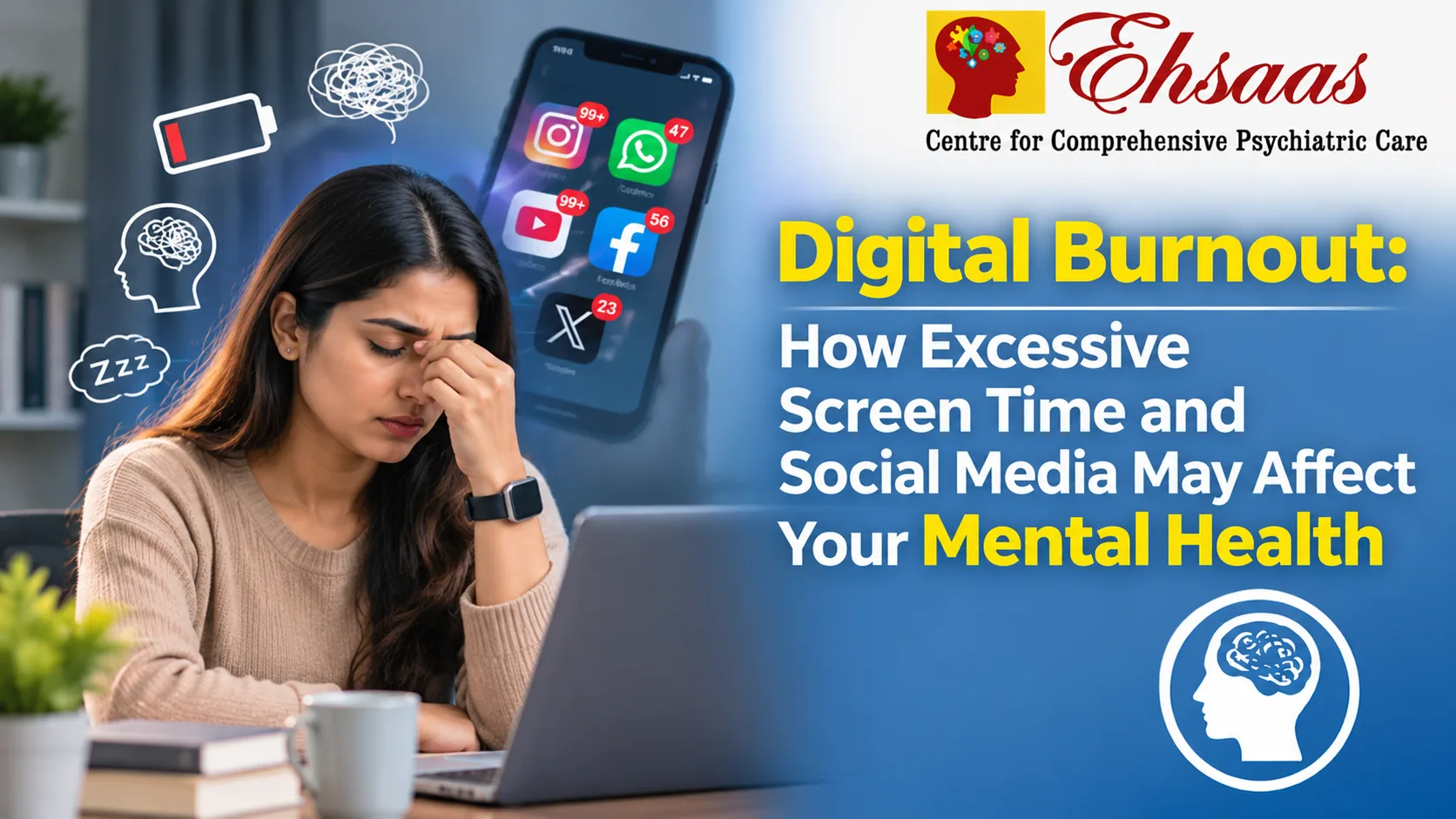
You pick up your phone to check one message. Forty minutes later, you are still scrolling, your eyes ache, and you feel worse than before. If this sounds familiar, you may be dealing with digital burnout. A psychiatrist in Delhi now sees this pattern more often, because work, messaging apps, and social media keep many people online from morning to night.
What Is Digital Burnout?
Digital burnout is a state of mental, emotional, and physical exhaustion linked to constant device use. It is not a formal medical diagnosis, but it can overlap with anxiety, depression, and sleep problems. A psychiatrist in Delhi can help you determine whether you're dealing with everyday screen fatigue or something that needs treatment. Many people only search for a psychiatrist in Delhi after months of poor sleep and constant tiredness.
How Do Screens and Social Media Affect Mental Health?
People often ask a psychiatrist in Delhi whether their phone habits are a problem. The honest answer depends on how they use screens.
Screens are not harmful in themselves. The problem is often how we use them:
- Constant notifications keep the brain on alert and make it hard to switch off.
- Endless feeds are designed so there is always more to see, which makes stopping difficult.
- Social comparison shows us edited versions of other people's lives and can leave us feeling behind.
- Blurred boundaries between work and home mean many people never fully log off.
- Late-night use can delay sleep and lower its quality, which affects mood the next day.
Research is still developing, and effects differ from person to person. For some people, heavy use is linked with low mood, loneliness, and anxiety. Social media also has benefits, such as staying connected. The goal is a healthier relationship with it, not necessarily quitting.
Signs of Digital Burnout
Look for patterns that last for weeks, not just one bad day.
Emotional signs: feeling low or irritable after being online, restlessness without your phone, fear of missing out, and loss of interest in things you enjoyed.
Mental signs: trouble concentrating, mental fog, and feeling overwhelmed.
Physical signs: eye strain, headaches, neck pain, tiredness that rest does not fix, and poor sleep.
Behavioural signs: checking your phone first thing in the morning and last thing at night, scrolling without really wanting to, and using your phone to escape uncomfortable feelings.
Also read: Can AI Chatbots Replace a Psychiatrist?
Screen Fatigue or Depression? When to Look for Depression Treatment in Delhi
Screen use alone does not cause depression, which usually has several biological, psychological, and environmental causes. But heavy use can sit alongside it. Someone who feels low may scroll more to escape, and that can affect sleep, activity, and connection with others.
| Everyday digital fatigue | Possible mental health concern | |
|---|---|---|
| Duration | A few days, eases after a break | Weeks or months |
| Mood | Tired or bored | Persistently low, anxious or hopeless |
| Sleep | Occasional late nights | Ongoing insomnia or oversleeping |
| Daily life | Manageable | Work, studies or relationships suffer |
If low mood has lasted two weeks or more, or you have lost interest in things you enjoy, it is worth speaking to a doctor. Depression treatment in Delhi is available through qualified psychiatrists, and an early conversation can help you understand what you are experiencing. Depression treatment in Delhi usually begins with a detailed assessment of mood, sleep, habits, and medical history.
8 Practical Ways to Reset Your Screen Habits
These habits support well-being. They do not replace professional care from a psychiatrist in Delhi if symptoms persist.
- Set a screen curfew. Put devices away 30 to 60 minutes before sleep.
- Turn off non-essential notifications.
- Charge your phone outside the bedroom.
- Schedule offline time for meals, walks, and conversations.
- Follow the 20-20-20 rule. Every 20 minutes, look at something 20 feet away for 20 seconds.
- Curate your feed. Mute accounts that leave you feeling worse.
- Replace, don't just remove. Choose exercise, a hobby, or time with friends.
- Notice why you pick up your phone. If it is to avoid a feeling, pause.
Also read: Stress Management in New Delhi
When Should You See a Psychiatrist in Delhi?
Consider a consultation with a psychiatrist in Delhi if:
- Low mood, anxiety or irritability has lasted for weeks
- Your sleep, appetite or concentration has changed noticeably
- You cannot cut down screen time despite wanting to
- Work, studies or relationships are suffering
- You use screens, alcohol or other substances to cope
- You have thoughts of harming yourself. In this case, seek help immediately.
A psychiatrist in Delhi is a medical doctor who can assess your symptoms, check for depression, anxiety or sleep disorders, and discuss suitable options. Depression treatment in Delhi may include counselling, therapy, or medication, depending on the person. Guidance on screen habits is often part of the plan. Treatment is personalised, and outcomes differ from person to person. Speaking to a psychiatrist in Delhi early can make the next steps clearer. You can contact Ehsaas to book a visit.
About the Doctor: Psychiatrist in Delhi
Dr. Manish Sarkar is a consultant psychiatrist in Delhi, practising at Ehsaas in Chittaranjan Park (MBBS, DPM from NIMHANS, Bangalore, FIPS, FADP). His practice covers depression and anxiety disorders, bipolar disorder, OCD, schizophrenia, substance use and addiction, child and adolescent psychiatry, stress-related disorders, and sleep disorders. He takes a patient-centred approach, with treatment plans tailored to each person. He is the founder of Ehsaas – Centre for Comprehensive Psychiatric Care. Patients looking for a psychiatrist in Delhi or depression treatment in Delhi can consult him in person or online.
Clinic: Ehsaas, J-1976, Chittaranjan Park, New Delhi – 110019. Timings: Mon–Sat 10:00 AM–1:00 PM and 5:00 PM–9:00 PM; Sunday 5:00 PM–9:00 PM. Phone: 9717755296 · 8527830987 · 011-41635296
Frequently Asked Questions
Is digital burnout a real mental health condition?
It is not a formal diagnosis, but it describes a real pattern of exhaustion linked to constant screen use. It can overlap with anxiety, depression, and sleep problems, which a psychiatrist in Delhi can assess.
How much screen time is too much?
There is no single number. What matters is whether screen use affects your sleep, mood, focus, relationships, or work.
Can social media cause depression?
Social media alone is not known to cause depression, but heavy use may worsen low mood or loneliness in some people. If low mood persists, depression treatment in Delhi is available through qualified doctors.
When should I look for depression treatment in Delhi?
If low mood, loss of interest, or hopelessness lasts two weeks or more, a psychiatrist in Delhi can assess what is happening and discuss options for depression treatment in Delhi.
When should I see a psychiatrist in Delhi for screen-related stress?
Consider it if anxiety, poor sleep, or exhaustion lasts for weeks or affects daily life.
Can I consult a psychiatrist in Delhi online?
Yes. Online and in-person consultations with a psychiatrist in Delhi are available at Ehsaas.

Medically reviewed by
Dr. Manish Sarkar , MBBS, DPM (NIMHANS), FIPS, FADP
This page is for general information and is not a substitute for a consultation. Treatment is decided individually after assessment.