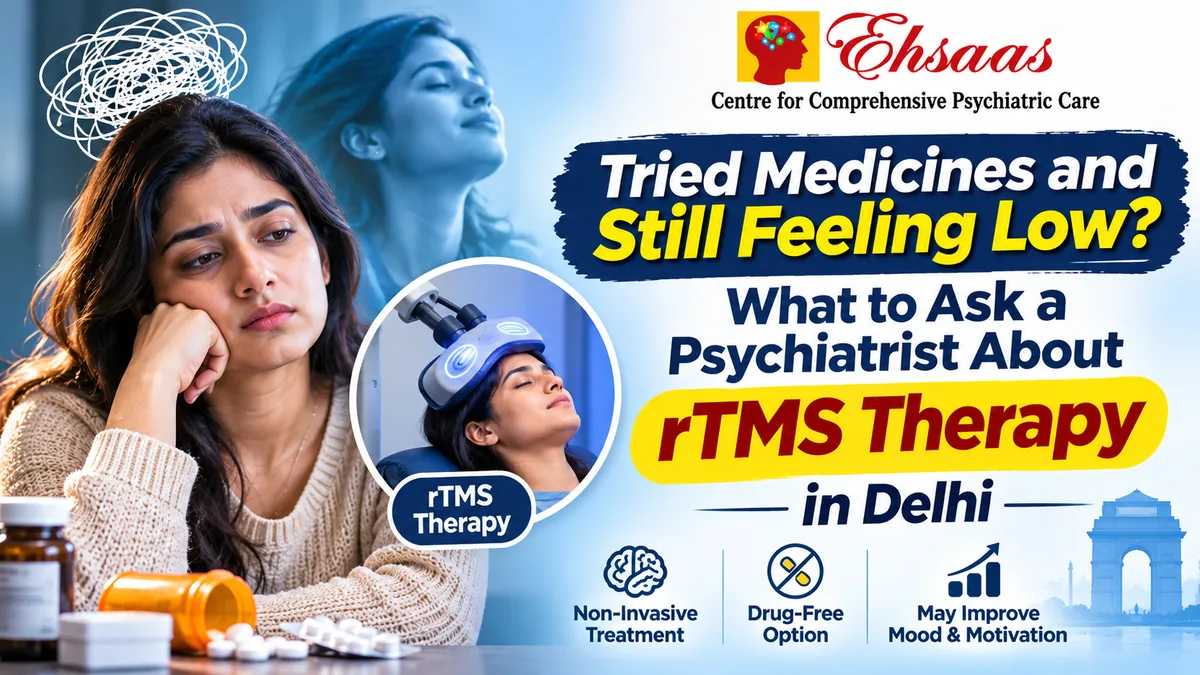
Transcranial magnetic stimulation (TMS) therapy for depression uses a magnetic coil held against the scalp to send pulses to brain areas that help regulate mood. Doctors may discuss it when medicines have not helped enough, but only a psychiatrist's assessment can say if it suits you. Our TMS treatment page explains more.
Key takeaways
- Feeling low after trying medicines does not mean you are out of options, but the next step should come from a full assessment.
- Before TMS is considered, a psychiatrist usually checks that your current treatment was given a fair trial.
- The treatment needs no anaesthesia and is given as an outpatient procedure, but it is not suitable for everyone.
- Safety screening comes first. Implants in the head and a history of seizures are among the things a doctor asks about.
- Write your questions down. A good consultation explains the plan in plain words and leaves the decision with you.
What is TMS therapy, and what is a session like?
TMS therapy uses short pulses of magnetic energy, delivered through a coil held against the scalp, to stimulate parts of the brain involved in mood. The repetitive form is called rTMS. It needs no anaesthesia and is done as an outpatient procedure, so you stay awake and seated. Sessions are repeated over a period that your doctor plans.
During a session you may feel a tapping or tingling sensation on the scalp, and the machine makes a clicking sound, so ear protection is commonly used. If anything feels uncomfortable, you can tell the person delivering the treatment. Your doctor will advise you on what to do after each session, including whether you can go back to your usual routine.
When might a psychiatrist consider TMS for depression?
Doctors usually think of TMS after other routes have had a fair chance: a medicine taken properly without enough relief, talking therapy that has not been enough, or side effects that make continuing a medicine hard. It is not a first step for everybody, and the decision follows a full assessment.
The UK's National Institute for Health and Care Excellence (NICE) reviewed the evidence on rTMS for depression and found no major safety concerns, with adequate short-term benefit, although the response differs from one person to another. Researchers have also studied the treatment in other conditions, such as obsessive-compulsive disorder (OCD), and your doctor can tell you whether that is relevant to you.
Medicines not working? What your doctor checks first
Before saying a medicine has not worked, a psychiatrist usually checks whether it was taken regularly, at a suitable dose and for long enough. They also look for other things that hold recovery back, such as poor sleep, alcohol, thyroid or other health problems, ongoing stress and untreated anxiety.
This is worth knowing, because "my medicine did not work" can mean several different things. Sometimes the dose needs adjusting. Sometimes a different medicine suits you better. Sometimes sleep or a health problem needs attention first. Please do not stop or change your medicines on your own.
Many people ask, "Does needing something extra mean I have failed?" It does not. Depression responds differently in different people, and a change of plan is a normal part of care. If TMS is advised, it is usually discussed as one part of the plan, not as a replacement for medicines or therapy, unless your doctor tells you otherwise.
What safety checks come before TMS?
Before the first session, the doctor asks about anything that could make the treatment risky for you. Metal or electronic devices near the head, past seizures or epilepsy, and some medicines are the main ones. Side effects are usually mild, such as a sore scalp or headache. A seizure is a rare risk.
To make the screening useful, take along:
- A full list of your current medicines, including supplements
- Details of any head injury, brain surgery or implants
- Any history of fits, blackouts or epilepsy in you or your family
- Your earlier treatment records, if you have them
What should you ask your psychiatrist about TMS?
Ask whether you are a suitable candidate, what the plan involves, how progress will be checked, and what happens if it does not help. Write your questions down before the visit. A good consultation explains the options in plain words and leaves the decision with you.
- Why do you think TMS may suit my depression?
- Have my current medicines been given a fair trial, and should anything change first?
- What safety checks do I need, and do any of my health conditions or implants matter?
- How many visits will I need, how long is each, and over how many weeks?
- How will we know whether it is helping, and when will we review it?
- What side effects should I expect, and what should I do if I notice them?
- Will I continue my medicines or therapy alongside it?
- Can I carry on with work or study during the course?
- What happens if TMS does not help?
- What is the total cost, what does it include, and is follow-up covered?
What does TMS therapy cost in Delhi?
The cost depends on the number of sessions, the protocol used and the centre, so a fair figure can be given only after assessment. Ask for the full plan and the total charges in writing before you begin, and check what follow-up is included.
We do not list a price in this article, because it would differ from one treatment plan to another. Results differ from person to person, so be wary of any centre that assures you of an outcome. A reliable clinic explains the limits of the treatment as clearly as its benefits.
When should you see a doctor?
You should see a doctor when sadness, disinterest, broken sleep or exhaustion has gone on for a fortnight or longer, or when prescribed medicines have fallen short of what you hoped. Do not wait if you feel hopeless. If you think of harming yourself, get emergency help at once.
To talk through your situation, you can reach the team at Ehsaas through our contact page or call 9717755296. You can read more about the doctor on the About page.
Last updated: 18 November 2026. This article is for information only and is not medical advice. It cannot replace a consultation with a qualified doctor.
Frequently asked questions
Is TMS the same as electroconvulsive therapy (ECT)?
No. TMS needs no anaesthesia and is not intended to cause a seizure. ECT is a different procedure, given under anaesthesia.
Is TMS painful?
Most people describe tapping or mild discomfort on the scalp. Tell the person delivering the treatment if it feels uncomfortable.
Does TMS work for everyone?
No. Response varies from person to person, and your doctor can explain what to expect in your case.
Can I stop my medicines if I start TMS?
Only your doctor can decide that. Please do not stop or change medicines on your own.
Is TMS only for depression?
Depression is the main use that has been studied. Other conditions, such as OCD, have also been looked at, and your psychiatrist can tell you whether it applies to you.
Which doctor should I see in Delhi?
A psychiatrist. They can assess your depression, review your medicines and tell you whether TMS is worth discussing.

Medically reviewed by
Dr. Manish Sarkar , MBBS, DPM (NIMHANS), FIPS, FADP
This page is for general information and is not a substitute for a consultation. Treatment is decided individually after assessment.