
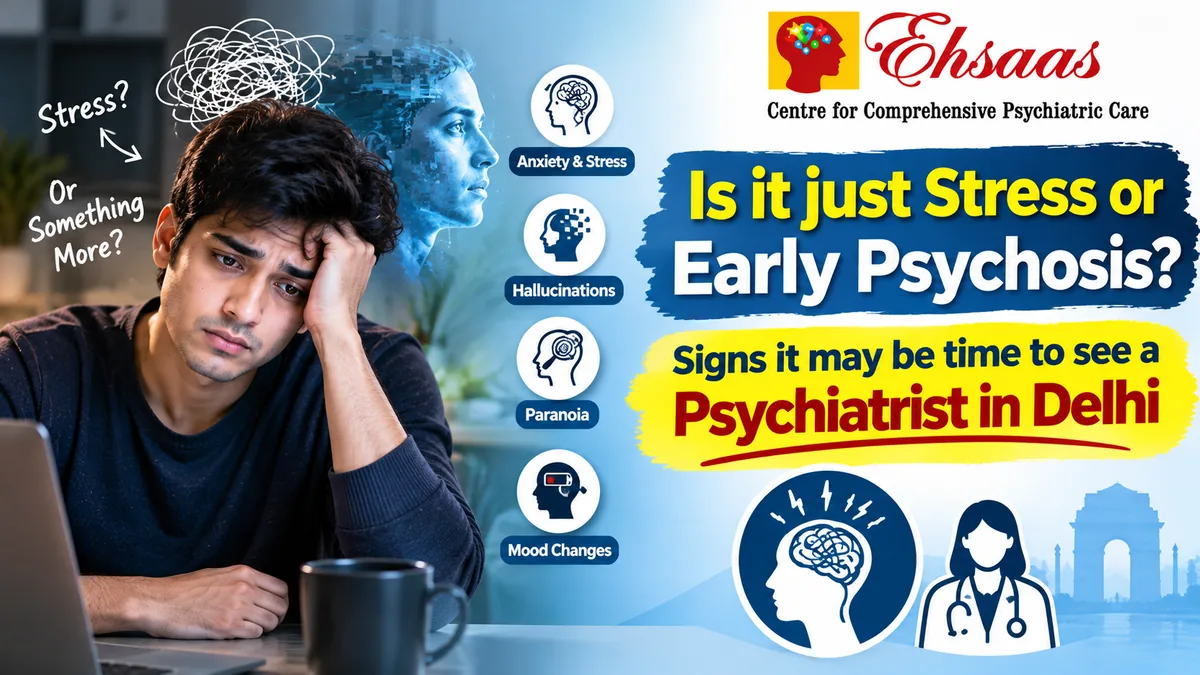
Early psychosis is a stage in which thoughts, senses or beliefs start to drift away from reality: a person may hear voices nobody else hears or feel certain of things that are not so. Everyday stress seldom does this. If it persists beyond a few days, consult a psychiatrist in Delhi. Our schizophrenia page outlines our approach.
Key takeaways
- Stress makes people tense and tired, but they still know what is real. In psychosis, the experience of reality itself changes.
- The early signs usually build over weeks or months: withdrawal, poor sleep, suspiciousness, odd remarks and a slide in study or work.
- Psychosis is not a character flaw, and it is not caused by weakness, faulty upbringing or black magic.
- Families can help most by staying calm, not arguing with the person's beliefs and getting a medical opinion early.
- Any talk of self-harm or of harming others should be treated as an emergency.
What is early psychosis?
Early psychosis is the opening phase of an illness in which a person's senses, beliefs or thinking drift from reality, and they find it hard to separate what is real from what is not. Many conditions can lie behind it, so the first job of a doctor is to find the cause.
The same experiences can arise in different illnesses, such as schizophrenia, bipolar disorder or very severe depression, after heavy substance use, or from a physical illness. Doctors usually describe three kinds of experience. Hallucinations are sensations without an outside source, most often hearing voices. Delusions are fixed beliefs that stay unchanged despite clear evidence to the contrary, for example that neighbours are plotting against you. Disorganised thinking shows up as speech that jumps between unrelated topics or is hard to follow.
People going through psychosis are far more often frightened and confused than dangerous. What they need is understanding and timely medical care, not blame.
How is stress different from early psychosis?
Stress leaves a person tense, tired and worried, yet they still know what is real. In psychosis the experience itself changes: someone may be certain they are being watched, or hear voices that nobody else hears. The table below sets out the common differences.
| Area | Ordinary stress | Possible early psychosis |
|---|---|---|
| Sleep | Poor sleep before a deadline, back to normal afterwards | Very little sleep for many nights, often with fear or unusual energy |
| Worries | About real problems, and can be talked through | Fixed beliefs, such as being followed or spied on, that stay even after explanation |
| Senses | Sounds and shadows seem sharper when tense | Hearing voices or seeing things that others cannot |
| Speech | Hurried or scattered when nervous | Hard to follow, jumping between unrelated topics |
| Daily life | Strained, but still coping | Stopping work or study, neglecting hygiene, staying shut in |
| Awareness | "I know I am overreacting" | Strong conviction that nothing is wrong, or that others are the problem |
A table cannot diagnose anyone. Its purpose is to show why a doctor asks what you are experiencing, not only how stressed you feel.
What are the early warning signs of psychosis?
Early signs often creep in over weeks or months rather than overnight. Common ones are a drop in study or work, pulling away from friends, sleep that goes off track, new suspiciousness, odd remarks and less attention to appearance. One sign alone means little; a cluster that keeps growing deserves a doctor's attention.
Thoughts and beliefs
- Growing suspicion that people are talking about, following or watching you
- Believing that ordinary events carry a special hidden message
- Ideas that others find strange but the person holds with total certainty
Senses
- Hearing voices or whispers when nobody is there
- Seeing shapes or people that others do not
- A feeling that the world looks or feels unreal
Mood and behaviour
- Pulling away from family and friends
- Sudden irritability, fear or flat, blank emotions
- Talking to oneself, or laughing or crying for no clear reason
Everyday functioning
- Marks, performance or attendance dropping sharply
- Stopping self-care such as bathing, eating regularly or changing clothes
- Sleeping through the day and staying awake at night
Here is an illustration, not a real case. A college student who used to be talkative begins to keep the curtains drawn, says the neighbours discuss him, and stops going to classes. Each detail alone could have a simple explanation. Together, over several weeks, they are a good reason to see a psychiatrist.
What can look like psychosis but is not?
Some problems imitate psychosis. Days without sleep, alcohol or drugs (or stopping them suddenly), a high fever or infection, certain medicines, thyroid disease, severe anxiety and even deep grief can all produce odd perceptions or ideas. A doctor rules these out before reaching any conclusion.
In grief, for example, a person may briefly hear or sense a loved one who has died, which is a common human experience and does not by itself mean illness. Beliefs and practices that are normal in a person's family, community or faith are also not treated as signs of illness. A careful psychiatrist asks about them with respect and looks at whether the person is distressed or unable to function.
What causes psychosis, and who is at risk?
No single cause is known. Risk seems to build from several sources: mental illness in the family, regular use of cannabis or other drugs, prolonged hardship or trauma, lack of sleep and some medical conditions. Having one of these does not mean psychosis will follow. It is never a sign of weakness, faulty upbringing or black magic.
This matters in practice, because blame delays help. Families who spend months asking "what did we do wrong?" or searching for a hidden cause often wait longer than they need to before seeing a doctor.
What should family and friends do?
Family and friends can help by staying calm, keeping the person safe and encouraging a medical check-up without arguing about what the person believes. Debating a fixed belief or mocking a voice usually increases fear. Note down the changes you have seen, and speak to a psychiatrist early rather than waiting for things to settle on their own.
Helpful
- Speak slowly and simply, and listen without judging
- Say that you can see they are frightened, without agreeing with every belief
- Keep the surroundings quiet and routines regular
- Offer to go with them to the appointment
- Keep a short written note of what you have seen and since when
Please avoid
- Arguing, laughing at or testing the person's beliefs
- Punishing or shaming them for strange behaviour
- Leaving them alone for long periods if they seem distressed
- Putting off a medical opinion while trying other remedies first
Families often ask "Is it our fault?", "Will he be sent away?" and "Will she ever be herself again?". These are natural fears. The answers depend on the person, and a psychiatrist can discuss them honestly once the full picture is clear. Many families find it a relief simply to have a name for what is happening and a plan to follow.
What happens at a psychiatrist's consultation?
At a psychiatrist's consultation, the doctor talks with the person, and usually with a family member, about what has changed and when. They ask about sleep, mood, substance use, health and family history, and may advise tests to rule out a medical cause. A treatment plan is then made for that person.
Care often combines medicines, talking therapies, support for the family and regular follow-up. Decisions are made together with the person, and medicines should never be stopped suddenly without the doctor's advice. Health services advise seeking help as soon as signs appear rather than waiting for them to pass.
When should you see a doctor, and when is it an emergency?
See a psychiatrist soon if unusual beliefs, voices, withdrawal or confused talk have lasted more than a few days, or are affecting study, work or home life. Treat it as an emergency if the person talks of harming themselves or others, feels commanded by voices, or is not eating or sleeping at all.
In an emergency, take the person to the nearest hospital emergency department or call your local emergency number, and do not leave them alone. If you are looking for psychosis treatment in Delhi and the National Capital Region (NCR), a planned consultation with a psychiatrist is the usual starting point. You can reach the team at Ehsaas through our contact page or call 9717755296. You can read more about the doctor on the About page.
Last updated: 18 November 2026. This article is for information only and is not medical advice. It cannot replace a consultation with a qualified doctor.
Frequently asked questions
Can stress cause psychosis?
Severe, long-lasting stress can contribute in some people, usually together with other factors. Ordinary everyday stress on its own rarely does.
Is psychosis the same as schizophrenia?
No. Schizophrenia is one condition in which psychosis can occur. Psychosis can also be seen in other conditions, such as bipolar disorder, severe depression and substance use.
Are people with psychosis dangerous?
Most are not. They are usually frightened and confused, and need care rather than blame. Any talk of harming oneself or others should still be treated as an emergency.
Can psychosis be treated?
Care is available, and outcomes differ from person to person. A psychiatrist can explain what to expect in your situation.
Which doctor should I see in Delhi?
A psychiatrist. If the person is a child or teenager, a child and adolescent psychiatrist is the usual first step.

Medically reviewed by
Dr. Manish Sarkar , MBBS, DPM (NIMHANS), FIPS, FADP
This page is for general information and is not a substitute for a consultation. Treatment is decided individually after assessment.