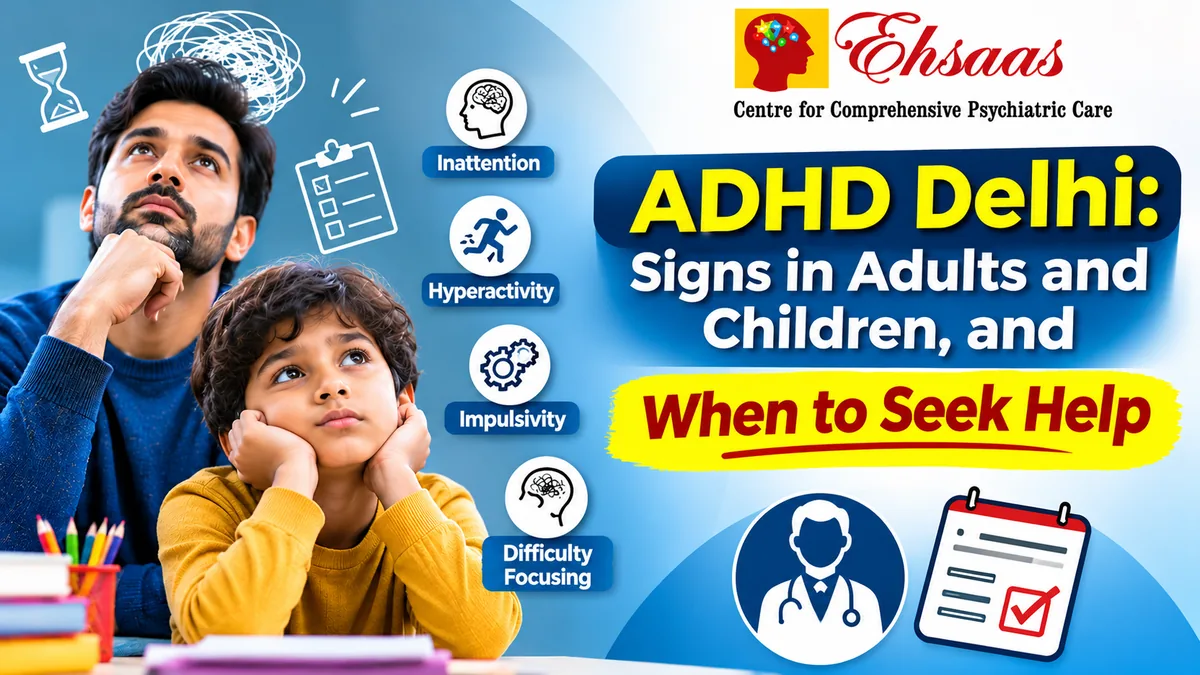
If you are looking into ADHD in Delhi, the first step is a clinical assessment: a psychiatrist for adults, and a paediatrician or child psychiatrist for children. ADHD means a long-running struggle with focus, restlessness or acting on impulse that gets in the way of daily life. See a doctor if this has lasted for months. Our ADHD page explains how we approach it at Ehsaas.
Key takeaways
- Missed deadlines, lost keys and a restless mind can be ordinary stress, or they can be part of a long pattern that deserves a proper look.
- The pattern matters more than any one bad day: how long it has lasted, where it shows up, and how much it costs you.
- Children and adults show ADHD differently, so the same condition can be missed in either group.
- A doctor's assessment, not an online quiz, is how ADHD is told apart from worry, low mood or poor sleep.
What does ADHD look like in everyday life?
In everyday life, ADHD usually shows up as a gap between what a person intends and what they manage to carry out: the bill meant to be paid on Monday is still open on Friday, the cupboard is checked three times for a phone that is in a pocket. It is a matter of how the brain organises effort, not of caring less.
Think of three small scenes. A student reads the same paragraph four times and cannot say what it was about. An office worker starts five tasks before noon and finishes none. A parent keeps interrupting at dinner because the thought feels urgent and will vanish otherwise. Any one scene is common. When scenes like these repeat across months and settings, a doctor starts to think about ADHD.
How do the signs differ in children and in adults?
Children usually show ADHD where adults can see it, at school and at home, while adults tend to carry it inside as disorganisation, poor time sense and restlessness. Because the outward picture changes with age, the same person can look quite different at 8 and at 38.
In children you may notice:
- Homework that takes far longer than it should, or is never handed in
- A school bag that is always missing something
- Difficulty staying in the seat, or waiting for a turn in a game
- Answers called out before the question ends
- Report cards that say "can do better" year after year
In adults you may notice:
- Running late even when you leave early
- Leaving tasks to the last night and then working in a rush
- A pile of half-finished projects
- Paperwork, bills and appointments slipping through
- A mind that never feels quiet, and trouble relaxing
A quiet child who daydreams is easy to miss, because nobody is being disturbed. Many adults first come in after a child is assessed and they recognise their own school years in the description.
Is it ADHD or just a busy mind?
It is more likely ADHD when the difficulties started early in life, have continued for around six months or longer, and appear in more than one area, for example both at home and at work. Occasional distraction during a stressful week, with normal functioning otherwise, is usually just life.
A racing mind at night deserves a separate word. Many people with ADHD describe it, but so do people who are anxious, who sleep at irregular hours or who scroll their phones in bed. On its own it does not point to ADHD. If it is frequent, tell your doctor, who will look at your sleep, your mood and your daytime attention together.
Worry, low mood, thyroid or other medical problems, poor eyesight or hearing, and learning differences can all look like ADHD. This is why a proper assessment is worth more than a ten-question online test.
Which doctor should you see for ADHD in Delhi?
For adults, a psychiatrist is the usual first doctor. For children and teenagers, a paediatrician or a child and adolescent psychiatrist is the usual starting point. A school counsellor and a clinical psychologist can add useful observations and, where needed, testing or behavioural support.
At our clinic, adults can book through the contact page or by calling 9717755296. You can read about the doctor on the About page.
What happens in an ADHD assessment?
An ADHD assessment is mainly a long, careful conversation. The doctor asks what you are finding hard now, what school and early life were like, how sleep, mood and health are, and whether anyone in the family has had similar difficulties. There is no blood test or scan that confirms ADHD.
With your permission, the doctor may also speak to a parent, teacher or partner, because others often notice things we do not. It helps to bring a few things along:
- A short list of situations where the difficulty hurts most
- Old school reports, or work feedback if you have it
- The medicines you take and a rough picture of your sleep
- Your questions, written down
What can help with ADHD?
Help is built around the person, not around a label. After an assessment the doctor may suggest explaining ADHD to the family, practical routines and reminders, changes at school or work, talking therapy, and, where the doctor finds it suitable, medicine. Medicine is always a medical decision, reviewed from time to time, and should never be started or stopped on your own.
Daily habits do not replace treatment, but they can make the day smoother:
- Fix a regular time for sleeping and waking
- Put reminders on your phone and write the day's three main tasks on paper
- Break a big job into steps that take twenty minutes each
- Keep a single tray for keys, wallet and documents
- Move your body daily
- Turn off notifications while you work
If someone you love has ADHD, give one instruction at a time, plan routines together and notice effort. Calling them "lazy" or "careless" tends to hurt and does not help.
What do people commonly worry about?
People most often worry that they will be judged, that ADHD is "just an excuse", or that medicine will change who they are. These are understandable fears. A good consultation is about listening to your whole story and explaining your options plainly, and treatment decisions stay with you and your doctor.
Parents often ask whether they caused it. ADHD is understood as a difference in how the brain develops, not the result of strict or lenient parenting. Adults often ask whether it is "too late" to ask. Doctors do assess adults, including those who were never looked at as children.
When should you see a doctor?
Book a consultation when attention, organisation or restlessness has been a problem for months and is affecting study, work, relationships, sleep or mood. Also go if a child's teachers keep raising the same concern, or if you feel permanently behind and cannot tell whether the cause is ADHD or something else.
If you ever feel you cannot cope, or have thoughts of harming yourself, speak to a doctor or contact a local emergency service straight away.
Last updated: 18 November 2026. This article is for information only and is not medical advice. It cannot replace a consultation with a qualified doctor.
Frequently asked questions
Can ADHD be diagnosed in adults?
Yes. The doctor looks at current difficulties and also asks about childhood.
Does ADHD go away with age?
In some people the signs lessen, in others they continue into adulthood. A doctor can tell you what is likely for you.
Is ADHD caused by bad parenting or too much screen time?
No. ADHD is understood as a difference in brain development. Screens and routines can affect anyone's attention, but they are not seen as the cause.
Can anxiety or lack of sleep look like ADHD?
Yes. Worry, low mood and poor sleep can all hurt concentration, which is why a full assessment comes first.
Is an online test enough to diagnose ADHD?
No. An online checklist can start a conversation, but only a qualified doctor can assess for ADHD.
Which doctor should I see in Delhi?
Adults can see a psychiatrist. For children, a paediatrician or child and adolescent psychiatrist is the usual first step.

Written by
Dr. Manish Sarkar , MBBS, DPM (NIMHANS), FIPS, FADP
This page is for general information and is not a substitute for a consultation. Treatment is decided individually after assessment.
References
- NHS. Attention deficit hyperactivity disorder (ADHD): overview, symptoms and diagnosis. NHS
- World Health Organization. Mental health: overview and resources. WHO
- NIMHANS, Bengaluru. Information for patients and families. NIMHANS
The first source explains symptoms and how diagnosis works in the UK health service. The second gives a wider picture of mental health care. The third is an Indian institute of mental health and neuroscience, and a useful place to read about child and adult psychiatry in India.