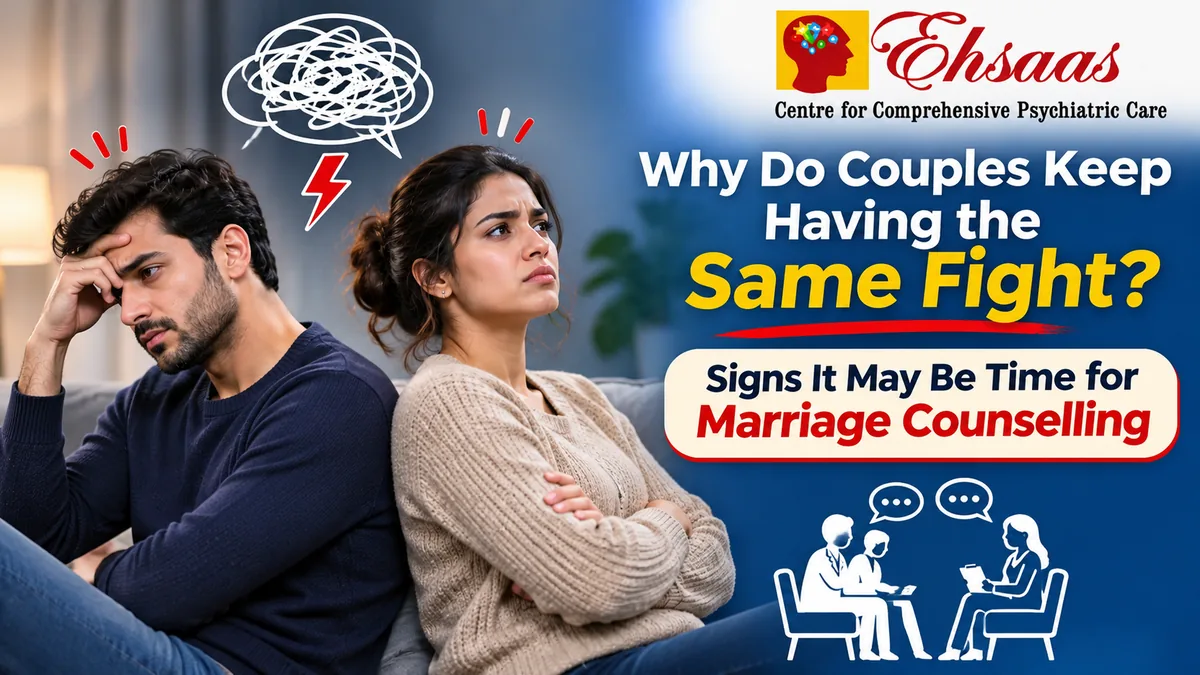
Couples keep having the same fight because the need underneath, such as feeling unheard or disrespected, never gets named, so only the surface topic is argued. If the loop will not break, marriage counselling in Delhi can help you both see what is driving it.
Last updated: November 2026. For information only, not medical advice.
It is the same argument again: the phone at dinner, the chores, the in-laws, the money. You promise yourself it will end differently this time, and it does not.
Key takeaways
- A fight that keeps returning is usually about an unmet need or a repeating pattern, not the topic itself.
- Occasional conflict is normal. A cycle that leaves both of you hurt, distant or afraid to speak is worth addressing.
- Stress, low mood and anxiety can make arguments more frequent and more intense.
- One partner can start counselling alone if the other is not ready yet.
- Results differ from couple to couple, and the doctor will explain what to expect.
Why do couples keep having the same fight?
Couples repeat the same fight because the need underneath, such as being heard, respected or reassured, stays unspoken. Without it, the surface topic is argued again and again, and each argument adds to the expectation that the next one will go badly. A fixed push-and-withdraw routine often keeps the loop going.
Repeated arguments are usually about what a topic has come to mean. "You never help" can stand for "I feel alone in this". "You are always on your phone" can stand for "I do not feel important to you". Over time each person starts expecting the worst from the other, so the next argument begins faster and ends worse.
Many couples also settle into fixed roles. One partner pushes for a conversation while the other pulls away to avoid conflict. The more one pushes, the more the other withdraws, and the more the other withdraws, the harder the first partner pushes. Neither partner is the villain. The pattern itself is the problem.
What are the most common arguments that keep repeating?
The most common repeating arguments are about money, household work, in-laws, phone use, intimacy, parenting and trust. The topics differ from couple to couple, but the hidden themes are often similar, as the table shows.
| What the fight looks like | What may be underneath |
|---|---|
| Money, spending and saving | Different ideas of security, control or fairness |
| Chores and household load | Feeling unseen, unappreciated or alone in the work |
| In-laws and family expectations | Feeling that your partner does not take your side |
| Phone and screen time | Wanting attention, closeness and priority |
| Intimacy and affection | Feeling rejected, pressured or emotionally disconnected |
| Parenting and decisions | Different values, or feeling that your voice does not count |
| Trust and honesty | Hurt that has not been repaired, or fear of being lied to again |
Is having the same argument always a sign of a bigger problem?
No. Recurring differences are part of every marriage, and a repeating topic alone does not mean the relationship is in trouble. The more useful question is how the arguments end: with some understanding and warmth returning, or with silence, insults and threats.
If the fights usually end in days of silence, name-calling or talk of leaving, it is time to pause and look at the pattern.
What are the signs it may be time for marriage counselling?
Consider counselling if the same dispute never closes, if talks turn into blame or sarcasm, or if home feels like shared space with a stranger. If several of the points below sound like your marriage, it may be time to reach out:
- You have the same argument again and again with no resolution.
- Conversations quickly turn into blame, sarcasm, shouting or contempt.
- One or both of you go silent for days after a disagreement.
- You avoid talking about important topics to keep the peace.
- Trust has been broken, for example by secrecy, lying or infidelity, and you cannot move past it.
- You feel lonely or disconnected even when you are together.
- You have stopped sharing small daily moments, affection or physical closeness.
- Arguments are affecting your sleep, work, health or your children.
- One of you has begun to wonder whether the marriage can continue.
You do not need to be at breaking point to ask for help. Many couples find it easier to work on a pattern earlier, before hurt has built up.
What can you try at home before counselling?
Before counselling, you can agree on a pause rule, keep each argument to one topic, start with your own feelings, and set a weekly check-in. These small steps lower the temperature of an argument. They do not replace professional help.
- Agree on a pause. Decide in advance that either of you can ask for a 20-minute break when things get heated, and that you will return to the conversation afterwards.
- Stay with one topic. Avoid bringing up old issues in the middle of a new disagreement.
- Start with your own feeling. "I felt ignored when…" is easier to hear than "You never…".
- Name the need. Ask yourself what you actually want from your partner in this moment: help, attention, reassurance or respect.
- Repair after a fight. A genuine "I am sorry I raised my voice" helps even if the disagreement is not fully settled.
- Set a weekly check-in. Fifteen minutes to talk about how you both are doing, away from children and screens, can stop small issues from piling up.
If you try these for a few weeks and the same fight keeps returning, that is useful information, not a failure. It may mean the pattern needs a neutral person to help you see it.
Can stress, depression or anxiety be behind the arguments?
Sometimes, yes. Research reviews describe a two-way link between relationship distress and conditions such as depression and anxiety. Strain at home can lower mood and raise worry, and a partner who is anxious, exhausted or low can struggle to stay patient and listen.
Some signs look beyond the marriage itself. One of you may be tense on most days, feel flat for weeks, lose interest in things once enjoyed, sleep badly, worry constantly, or drink more than before. A psychiatrist can assess these alongside the relationship concerns. You can read more about depression and anxiety on this site.
How does marriage counselling work?
Marriage counselling, also called couples therapy, is a structured conversation with a trained, neutral professional. It does not aim to decide who is right. The focus is on the pattern between you.
- First visit. You describe what is happening, what you have tried and what each of you hopes will change.
- Understanding the pattern. The professional helps you see how each of you contributes to the cycle and what need sits underneath.
- Building skills. You practise listening, speaking about difficult topics and repairing after conflict.
- Looking at wider factors. Stress, mood, anxiety, trust, family pressures and past hurt are discussed where they are relevant.
Published reviews of couple therapy report improvements in relationship satisfaction and communication on average. They also show that results vary between couples and between approaches, and that some gains can fade within months. For that reason, counselling is better understood as a way to give a couple better tools than as a promise of any result for any one marriage.
Can counselling help if only one partner is ready?
Yes, one partner can start alone. Attending alone helps you understand the pattern, work on your own responses and plan how to invite your partner when the time is right. Pressure or ultimatums rarely help. An open invitation, such as "I would like us to understand this better together", usually works better.
When should you seek urgent help?
If there is violence, threats or fear in the relationship, your safety comes first and counselling is not the right first step. In an emergency, dial 112. Women Helpline 181 supports women facing violence or distress, and Tele-MANAS (14416) offers free mental health support by phone. If you are having thoughts of harming yourself, please contact a doctor or a helpline immediately.
What to expect at Ehsaas, Chittaranjan Park
Couples who come to Ehsaas in Chittaranjan Park meet Dr Manish Sarkar, a psychiatrist, to talk through communication gaps, broken trust and emotional distance. If you are looking for couple counselling in Delhi, one partner may begin alone. The visit is private, and any low mood, anxiety or stress can be discussed in the same consultation.
To book a consultation, use the contact page or call 9717755296. You can also read more about marriage counselling at Ehsaas and common marital problems.
Frequently asked questions
Is it normal to keep fighting about the same thing?
Yes, many couples have recurring disagreements. It becomes a concern when the arguments leave you hurt, distant or afraid to speak, or when they affect your sleep, work or children.
Can marriage counselling work if my partner will not come?
You can start alone. Many people begin by understanding their own part in the pattern and by planning how to invite their partner. Whether the partner joins later is their choice.
Do we need a counsellor or a psychiatrist?
If the main issue is communication and conflict, a trained counsellor or therapist may be enough. If low mood, anxiety, sleep problems, substance use or other mental health concerns are also present, a psychiatrist can assess them. A first consultation helps clarify which is needed.
How many sessions will we need?
This depends on the couple and the concern, so there is no fixed number. The clinic can discuss what is suitable for you at the first consultation.
How can we prepare for the first session?
Before you go, each of you can jot down a couple of recent arguments, the change you hope for, and any health, sleep or work pressure on your mind. Go ready to hear your partner and to be heard.
Will counselling save our marriage?
No professional can promise that. Counselling helps both partners understand the pattern between them and make more informed choices about their relationship.
References
- Roddy et al. Meta-analysis of couple therapy: effects across outcomes, designs, timeframes, and other moderators. Journal of Consulting and Clinical Psychology. 2020;88(7):583-596. PubMed
- Rathgeber et al. The efficacy of emotionally focused couples therapy and behavioural couples therapy: a meta-analysis. Journal of Marital and Family Therapy. 2019;45(3):447-463. PubMed
- Research on the treatment of couple distress. Journal of Marital and Family Therapy. 2012;38(1):145-168. PubMed

Medically reviewed by
Dr. Manish Sarkar , MBBS, DPM (NIMHANS), FIPS, FADP
This page is for general information and is not a substitute for a consultation. Treatment is decided individually after assessment.